Themes of ethics are ones that I particularly enjoy exploring, because good and bad morals have changed completely throughout the centuries. Even nowadays it's difficult to determine whether certain things are ethically good or bad, and that's the most fascinating thing about. We often turn to the law or religious books to decide where we stand on our ethics, since they are decided by large groups to define. However, these contradict what true ethics are. There are plenty of theories that contradict each other, but I for one follow the Subjective Relativism theory, in which there are no universally decided morals, just what we decide for ourselves. I also think Cultural Relativism is defined from this, in which ethics are derived from our cultural understanding of them. Meaning some things are ethically wrong in one country but not in another country. This is, however, due to what I stated about law and religion deciding our ethics.
While I do see the importance of law and order, they don't entirely define our ethics, because some laws are ethically wrong overall, such as the law that gay people can't get married. It's an unfair law but still a law nonetheless. These are also ethics decided for us by the government, and following ethics enforced by others is a detriment to society.
There is also an issue of self-righteousness due to the connotations of ethics. If a person does something that they think is right and tells people how right it was then that's the type of mentality that can lead to fascism. Hitler, for example, did what he did because he believed it was the right thing to do and refused to accept that it wasn't, and he got that much power because he led people on to believe it was right as well. The mentality still exists as well, as there are plenty of political groups out there, KKK, UKIP, BNP, and EDL, that strongly believe what they are doing is ethically right to point where logic and reason is not a factor anymore. Their goals are set in stone so there is nothing anyone can do to prevent it. That's not how ethics work in a perfect world, because one man's ethics should not be enforced onto other people, otherwise large groups of fascists will continue to be a problem. Although there is also an essence of ego-gratification in this, which is an uncontrollable aspect of human nature. It works in the way that a person will have similar ethics to a group and said group will use that to manipulate this person to join them, and once that person feels accepted in the group, they get the urge to enforce the ethics onto others, and as the numbers increase, so does the satisfaction of the group members.
I always love exploring themes like this, because they inspire a lot of ideas regarding character traits and motivations. I also think there are issues that can be addressed within a narrative about this that can lead to some very memorable storytelling. In fact, they are commonly used as themes in The Legend of Korra, since the villains in that series are all portrayed as villains with a tonne of layers that define their motivations through what they deem as right.
Thursday, 19 February 2015

Tuesday, 17 February 2015
City and Film - Memorable Landscaping in Animation

An admirable trait for visual mediums is often the ability to portray a city setting in a memorable fashion. It is a common trope among film noir that the city setting is emphasised greatly and portrayed in a dark manner, with heavy shadow, edgy locations, and high contrast streetlights in a nighttime setting. In sci fi films set in the future, it is often imperative that the city setting be as imaginative and ambitiously designed as possible. This is why films like Blade Runner and Metropolis are popular examples of future settings.
The use of architecture is not only limited to live-action film either, cartoons like Batman: the Animated Series, and Futurama focus greatly on the city and landscapes. The video game, The Wolf Among Us is deliberately film noir inspired in terms of approach towards the areas of the city scenes are set in.
It is common for animations that take place in a fictional world to take inspiration from real life and other fictional settings and landscapes. For examples, there is an area in Dark Souls called Anor Londo that is based on the Milan Cathedral, and was remarkably designed to make the player feel accomplished as they make it there. In fact Dark Souls is known very well for its ability to tell the story in the architecture. Similarly to how Adventure Time hints at its backstory, the areas in Dark Souls are designed with mise-en-scene that effectively hints at the game's lore.
Friday, 13 February 2015
Consumerism - Persuasion, Brand, Society, Culture
Consumerism is something I am both for and against. I am for consumerism because it has and still does help the country develop, but the means in which consumerism is taken advantage of are still really unethical. The consumerist society is all driven by the products we buy and the gratification society gains from it. The devices we own, the movies we watch, and the objects we bought, they are all drawn by our egos and the sense that we our accepted if we own these products. Granted, after looking at psychoanalysis (which does play a large role in consumerism), I've grown to accept that our culture is solely driven by the things we own, since changing this would be like changing human nature, almost impossible. We all have a tendency to compare ourselves to others, and advertisers take advantage of this to sell their products. Again, it's unethical but effective, and it seems to be the only possible method towards advertising at this point.
My problems with consumerism come from personal feelings of anguish, having never owned a smart phone whereas literally everybody I know owns one. It's a really dumb thing but what with most of the marketing these days being focused towards people that own smart phones, I sometimes feel left out. This because I don't own a god damn phone. This is exactly what the companies that makes these products want me and everybody else to feel. It's a screwed up system indeed, now that a product as simple as a portable phone can cause disharmony because of consumerism.
Knowing this would be beneficial if I wanted to be an animator for advertising companies, since I know it's all about ego gratification, and what we as a society deem pleasurable.
My problems with consumerism come from personal feelings of anguish, having never owned a smart phone whereas literally everybody I know owns one. It's a really dumb thing but what with most of the marketing these days being focused towards people that own smart phones, I sometimes feel left out. This because I don't own a god damn phone. This is exactly what the companies that makes these products want me and everybody else to feel. It's a screwed up system indeed, now that a product as simple as a portable phone can cause disharmony because of consumerism.
Knowing this would be beneficial if I wanted to be an animator for advertising companies, since I know it's all about ego gratification, and what we as a society deem pleasurable.
Wednesday, 11 February 2015
Studio Brief: Creative/Animated Visual Response
Since my essay for this module is about how executive producers change stories and narratives to suit their needs, my visual response would have to be appropriate for this. I want to see if I can incorporate this into animation, but given the time restraints, I may not be able to be too overly ambitious with this. I was thinking if I did make one, it would have to be purely visual-driven, and not fully animated. What I mean by this is the animation would have be very cheap and simple, which I can totally do. This could actually be beneficial as well, to see if I can be entertaining without actually using "good" animation.
Think of something along the lines Panty & Stocking with Garterbelt or South Park, which get away with being rather crappy looking by being hilarious and fun to watch.
My idea is to take the feedback given by network executives, vocalise them, and animate the reactions in whatever context comes to mind. I'll choose from a list I made by looking at the twitter account @TvNetworkNotes, which posts real responses given to writers, directors, artists, etc. by network executive producers. This would of course be purely comedic and satirical, because these notes are rich with material!
I'd do several takes for each note and animate each of the audio samples depending on how much time I have, but I imagine this would be no more than 1 minute long, depending on how much time I have. It's something that relates to my point about executive producers changing material, not entirely getting the point of the stories, and trying too hard to pander to audiences, even if it means affecting the quality of the product.
Think of something along the lines Panty & Stocking with Garterbelt or South Park, which get away with being rather crappy looking by being hilarious and fun to watch.
My idea is to take the feedback given by network executives, vocalise them, and animate the reactions in whatever context comes to mind. I'll choose from a list I made by looking at the twitter account @TvNetworkNotes, which posts real responses given to writers, directors, artists, etc. by network executive producers. This would of course be purely comedic and satirical, because these notes are rich with material!
I'd do several takes for each note and animate each of the audio samples depending on how much time I have, but I imagine this would be no more than 1 minute long, depending on how much time I have. It's something that relates to my point about executive producers changing material, not entirely getting the point of the stories, and trying too hard to pander to audiences, even if it means affecting the quality of the product.
Tuesday, 10 February 2015
Psychoanalysis: How it can Apply to Animation
This is a very deep and complex look at how humanity functions beyond our animalistic desires, and how we differentiate to each other. I can't exactly summarise everything beyond the great Sigmund Freud's amazing "Mind's Three Structures" theory - Id, our deep and natural desires as a species; Super Ego, what we call our conscience, basically governs how we act socially and what we see as right and wrong; Ego, how we act consciously depending on what the super ego convinces us - but it is very important as a tool for understanding characters and being able to write them in such a manner to make them realistic.
 |
| There are multiple versions of this metaphor that depict the position of the super ego differently. |
Of course, naturally the human psyche is split into far more elements than just those three, but this is just a summary, following the rule of thirds, that shortens them down to three. How this applies to animation is not really any different to any form of media. As I said, characters are far more engaging within a story when the character is written with their psyche in mind. If a character has this level of depth, audiences will engage with them far more and understand their actions.
Psychoanalysis can also be applied to stories depending on their genre. A psychological horror like the Silent Hill games for example will take advantage of the character's emotions, desires, and nature. They also tend to adapt to the player's gaming habits and use them to affect the story and scare them. Movies and TV shows use the human psyche for surrealist purposes, like portraying characters as unconscious beings within a dream-like atmosphere. Un Chien Andalou, for example, is deliberately made to resemble a dream, and they do so by having no consistent narrative structure or characters, but the characters act like they lack any ego or even super ego and therefore act very strangely. This is basically showing how people would act given the mentality of the unconscious mind.
I will definitely be incorporating Psychoanalysis to my future projects, as I am very enthusiastic about the idea of making psychological horror/thrillers. It is also useful to me for satirical purposes, as I feel like psychoanalysis factors a lot in most of the issues we face, and I enjoy poking fun at human nature because it's something we can't control.
Friday, 30 January 2015
Visual Analysis: Bottle (2010) & The Dog Who Was a Cat Inside (2002)
Bottle, and The Dog Who Was a Cat Inside are both low-budget, indie animations, that effectively work around their lack of production values by using cheap methods that compliment their visual style. Bottle uses litter found on the beach, sand, snow, and objects found in the forest, which are obviously free unless you have to pay mother nature for that stuff. Whereas The Dog Who Was a Cat Inside, uses a very simple art style and method for animation. Since the characters in it comprise of mainly shapes, they get away with animating it without putting much thought on the in-betweens, dodging many basic principles of animation, as well as animating at an exceptionally low frame-rate.


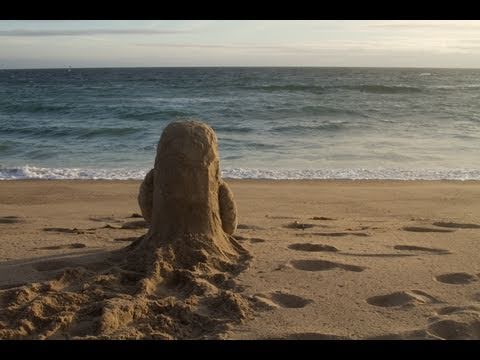
Bottle has some impressively consistent lighting, considering it's shot mainly outside, taking time of day and weather into account. The Dog Who Was a Cat Inside is also quite impressive in terms of this, as it manages to establish day and night effectively, as well as having rather smooth transitions between them.
It's unclear if the content for Bottle was meant to be telling us something. How the two characters meet is clearly meant to be synonymous with online dating, only it's through the classic note in a bottle trope. Of course they have to communicate that way, since they can't exactly swim to each other, but they end up connecting so much that they decide that they have to meet each other in person. They obviously only thrive in their own environment but want to meet each other anyway. This could also symbolise the online daters' own comfort zones being so opposite that they couldn't handle each other? In The Dog Who Was a Cat Inside, the content is quite clearly supposed to resemble a man that feels like a woman inside, and trying to come to terms with that. It could, however, also be about the difference between being masculine and feminine, and trying to find that harmonic balance between the two. Or it could just be about a dog trying to suppress it's inner catlike instincts. This one is a lot more open to interpretation than Bottle.
Bottle is pretty relevant for the time it was made, if my interpretation for the themes are correct, as online dating was very popular in 2010, to the point where dating sites were (and still are) even being advertised on TV. When The Dog Who Was a Cat Inside was released, in 2002, transgender was quite the touchy subject. No one really called it "transgender" that often, actually, because people thought it was a sexuality, and mainly referred to it as "transvestism", and people were referred to as "transvestites" regardless of whether or not they wore the opposite gender's clothing because they identified as them or just felt comfortable in them. Of course, this is still assuming The Dog Who Was a Cat Inside intended on actually having that correlation with this theme. Context would be a factor into this if it was the case.
There wasn't much emphasis on music in these shorts, in fact there was no music at all in Bottle, but they each work around this in their own ways. In Bottle, as I said, there is no music but rather environmental noises, depending on the setting the sounds were mainly ocean noises in the beach scenes, and windy noises in the snowy scenes. There is some very decent sound-design in this, actually, although the sound of the sand scraping the glass bottle goes right through me, I guess that's a good sign on their part though. The music in The Dog Who Was a Cat Inside was pretty generic Paris background music, nothing exactly to write home about, but it does establish the setting and tone effectively. The sound effects are also subtle but well done. It is rather obvious that the dog and cat noises were done by people, but I actually think it works here as it sounds rather silly, adding to the more comedic tone of this short.
Bottle was basically made to tell a cute love story with kind of a twist in the way it turns out, so it works in that sense. Like most indie shorts, it wasn't really meant for a specific target audience. The correlation in it should be more familiar with adults, but it doesn't exactly target them as an audience. It's tone of voice is appropriate for adults and young people, not being too dark or too light. It might actually be that the point of Bottle was to introduce kid's to these adult themes in a fairly light tone of voice. The Dog Who Was a Cat Inside is kind of similar in the sense that it kind of exists just to tell a cute story with real-world themes that a select group of people might be familiar with, but does it in a tone of voice that would appeal to both adults and children, though I think this might appeal to children slightly, because it's not as slow as Bottle and has that rather nice looking 2D/3D art style.
Subculture: My Thoughts.
Subcultures mainly consist of groups of people that like to distance themselves from the norm of society, typically due to the oppressive nature of whichever culture they belong to that demands that their social standards be met quite strictly. A few examples of this include goths, street punks, and hippies. This is typically done by dressing and styling themselves in a certain manner beyond social standards, as well as acting unconventionally. Sub-cultures are usually considered rather edgy and controversial, due to society's anxiety towards irregular folks within their community.
Subcultures are often looked down upon but some find their attitude and fashion-sense rather appealing. For this reason, you often find people not part of a subculture but still dressing like them. This has led many clothing stores to market their fashion products towards subcultures and people that look up to them. This kind of breaks the idea of subcultures, since the point of them is to go beyond the norm, and yet their style has become marketable.
Recently, "geek culture" has become rather popular, possibly due to TV series like Big Bang Theory and IT Crowd, and, in my opinion, it has actually led to a more positive perspective on geek culture within society, since before then it was considered more shameful to follow that lifestyle. Both the term geek culture, and people actually identifying as "geeks" is evident that this has essentially become another subculture. Granted, I am someone that by definition fits into this category of subculture but doesn't really identify as it. I feel like the difference between subcultures and everybody else is that they take pride in the fact that they are distancing themselves from society.
I personally think the very existence of subcultures is rather contradictory if the idea is go beyond the norm. They basically end up creating their own norm within their subculture, which is no different to what they were trying to avoid. I mean, are they trying not to conform by... conforming to their own culture? I don't have a problem with people being different, though. I wholeheartedly support individuality, but I don't think developing a group of people to celebrate this is necessarily the right thing to do. I always see subcultures as types of tribes, because people are basically forming a group based on their own differences and live in that particular manner. They create their own comfort zone because of this, and when they see other people/groups outside of that comfort zone, their instincts tend to vary between fascination, confusion, and irritation, most often the latter of the three. I believe this violent aspect of human nature as a species hasn't yet evolved since the Dawn of Man.
Subcultures are often looked down upon but some find their attitude and fashion-sense rather appealing. For this reason, you often find people not part of a subculture but still dressing like them. This has led many clothing stores to market their fashion products towards subcultures and people that look up to them. This kind of breaks the idea of subcultures, since the point of them is to go beyond the norm, and yet their style has become marketable.
Recently, "geek culture" has become rather popular, possibly due to TV series like Big Bang Theory and IT Crowd, and, in my opinion, it has actually led to a more positive perspective on geek culture within society, since before then it was considered more shameful to follow that lifestyle. Both the term geek culture, and people actually identifying as "geeks" is evident that this has essentially become another subculture. Granted, I am someone that by definition fits into this category of subculture but doesn't really identify as it. I feel like the difference between subcultures and everybody else is that they take pride in the fact that they are distancing themselves from society.
I personally think the very existence of subcultures is rather contradictory if the idea is go beyond the norm. They basically end up creating their own norm within their subculture, which is no different to what they were trying to avoid. I mean, are they trying not to conform by... conforming to their own culture? I don't have a problem with people being different, though. I wholeheartedly support individuality, but I don't think developing a group of people to celebrate this is necessarily the right thing to do. I always see subcultures as types of tribes, because people are basically forming a group based on their own differences and live in that particular manner. They create their own comfort zone because of this, and when they see other people/groups outside of that comfort zone, their instincts tend to vary between fascination, confusion, and irritation, most often the latter of the three. I believe this violent aspect of human nature as a species hasn't yet evolved since the Dawn of Man.
Subscribe to:
Posts (Atom)