Showing posts with label CoP2. Show all posts

Monday, 23 March 2015

Practical/Visual Response Development work

There isn't a lot in terms of development work, what with the little time I've had to make this, I basically ended up making it the more I went along, if you get me. There are a few details to add, though.


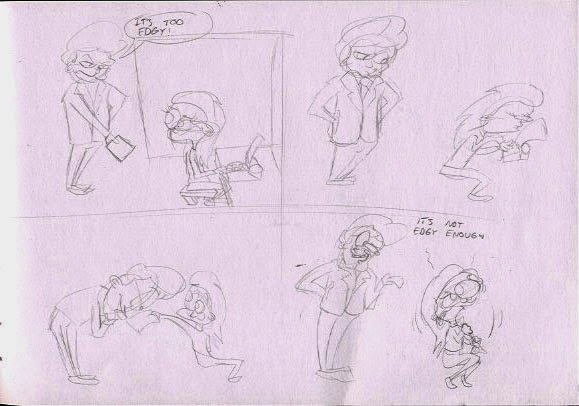
These are the sheets with all the tweets I was gonna quote in the animation. I was originally gonna read out all of them with a distinct voice for each one, but I only had time to record three, unfortunately. This was essentially my script, both to use as reference for each scene while I was sketching them out, as well as to actually voice the characters with (obviously). To be honest, some of these are gold while others I can't really visualise (this is why prefer storyboards over scripts).


These were some of the sketches I made, just to see how the idea will look in my head. As you can tell, that dude with the quiff was meant to be the guy in all the scenes, but it didn't really make sense, since all the notes are from different studios, and I kind of imagined different looks for each producer; perhaps if the design was refined a bit more I could have made that idea make sense. The art was mainly inspired by Chuck Jones and John Kricfalusi's art, since I was only focusing on keyframes, and not actually animating them all (again, time), and that style of exaggeration does a great job at adding character and establishing emotion to still images.

woooooaaahhh foreshortening

I added more negative space on the far right to give the camera room to pan.


This is how they look in the end. I focused a lot more on the composition side of these scenes. I gave the characters room to move around and truly emote within the environment. The backgrounds look like trash, I'm not gonna lie. I wanted them to look extra silly and to shift more focus on the characters. They still don't look good, but they get the job done, at least.

That's everything. It's not much, I know. Hopefully by next year, I'll have more time to plan the next visual response out.

Identity: My Thoughts

Identity has become a very touchy subject recently, what with gender, racial, and sexual identities being a topic of debate among many people. To be honest, it's nobody's business what defines a person's identity, but I understand why some will get irritated by other people over it. People tend to lead themselves to believe that the most basic form of identity is all that matters, when that contradicts the nature of sociology within humanity. Every person has their own distinct nature, personality, mentality, appearance, and attitude, all of which, and more, being the elements of one's identity. These identities are all given labels, because society functions simply by following these labels, I find. It also seems that when some new identity with a new label comes along, or somebody identifies as something else, despite containing all the attributes to a specific identity, society as a whole begins to fall apart because it seems to me like this is a concept that no understands immediately, or that some people refuse to see something like this change.

I believe the reason some people create an identity for themselves is because they get confused about who they really are and an answer to that question as all the more emotionally satisfying. This is a totally legitimate reason to seek an identity, because all some people need to move on from the difficulties of life are answers. And I won't deny that, recently, the internet has become rather infested with people who take advantage of this logic for attention. People tend to deny this but I happen to be close friends with people who are legitimately transgender and/or suffer from mental illnesses, and they don't shove it in people's faces and tell everyone how "oppressed" they are over their identity half as much as those pretenders do. I sound bitter over this but I legitimately get so frustrated when people make up reasons to say they're "oppressed" (that's pretty much a buzzword, at this point, on Tumblr). It only trivialises real-life oppression towards people over their identities.

As mentioned before, a lot of people don't immediately grasp the concept I brought up earlier about the satisfaction of finding an answer to the question of one's own identity. I feel like it should be something people are taught in school or by their parents at an early age. If people understood the reason some girls choose to identify as boys, and vice-versa, or just the fact that there are several more identities out there than what the media leads people to believe but make people less inclined to get frustrated at the notion.

Sunday, 22 March 2015

The Producers - Money, Movies, and Who Really Calls the Shots


I referenced this book quite a bit in my essay about whether or not producers are a detriment to entertainment. I particularly talked about the section talking about Dino De Laurentiis, because it brings up a very interesting concept regarding the subject. Basically, the way De Laurentiis works as a producer, according to the book, is that he separates his films into production movies, films in which he funds them solely for profit, and auteur movies, which is pretty self-explanatory. This was particularly interested when the book went into detail about how De Laurentiis and David Lynch collaborated. They both agreed on a contract in which Lynch had to make a blockbuster film (Dune) and in exchange he got to make an independent film of his choice (Blue Velvet), but since Dune ended up being a huge flop, Laurentiis only gave Lynch $6 million to fund his next film.

The reason this fascinated me was because it made me think about why producers would make a film for profits in the first place. Sure, some producers might only care about the money but given Laurentiis' working habit, he seems to put money as a high priority in order to even allow his directors to have the creative freedom they need for their project. Sometimes an auteur will be so overly ambitious when given the amount of freedom they want that they end up needing more money for their films, so the producers can afford to sacrifice quality for cash, in order for art to prevail. This really changed my view on producers as a whole in general. Keep in mind, I've always known what the actual role of the producer is, but I know some work differently to others, and this book even categorises them.

Monday, 16 March 2015

Globalisation and Sustainablility

I don't know what to make of globalisation, honestly. I mean the definitions I hear, the socialist and capitalist, both leave a bad taste in my mouth. They both seem to have connotations of fascism to me. I guess I'm just new to this concept, I mean I've always somehow encountered it but no one's ever really explained it to me. Basically, from what I can understand, the general definition is of globalisation is the act of political and/or sociological influence from one nation to another, operating on a global scale. There are apparently definitions exclusive to socialists and capitalists.

The socialist definition is, and I quote, "The process of transformation of local or regional phenomena into global ones. It can be described as a process by which the people of the world are unified into a single society and function together. This process is a combination of economic, technological, sociocultural and political forces." So, from what I can gather from this, it basically means every culture applying their social, economical and political standards into one sustainable global culture. This is a very ambitious... no... naive idea. There are far too many things to consider and to eliminate in order for this idea to be successful. I mean there's the ethics of each culture for starters, because different cultures will find some things unethical whereas others won't, causing far more chaos than order. There's also the fact that different cultures succeed in terms of economical stability. Some have a very stable, and even beneficial system as opposed to others which effectively screw over the country, but there are still people that will find reasons to support their bad economy. There's also factoring in political forces, which, again, there are still people that will hold onto their political views very strongly, so expecting everyone to follow one imaginary global view is asking far too much. This goal of globalisation basically forgets that people are not only each unique individuals but also animals that will fight if there is any disharmony, whether that's regarding their views, their economy, or pretty much anything that contradicts what they stand for. That's the reason their are wars and crime in the world, and bringing all these people together would be like mixing the wrong kinds of acids, causing a lab to explode.

The capitalist definition is, "The elimination of state-enforced restrictions on exchanges across borders and the increasingly integrated and complex global system of production and exchange that has emerged as a result". This seems to be the definition people tend to focus on, since it relates to westernisation/americanisation. It basically eliminates any borders that block economical negotiation and exchanges between different cultures, essentially benefitting from their better economy. It's a system which has benefitted the country and its industries for years, but at what cost? Well there's advantages and disadvantages to this system. Firstly, let's just say there's a reason people here "globalisation" and immediately think of the terms "westernisation/americanisation". American culture has become the most dominant and well-known one in the world and it is because of how capitalist the country is.

One thing that brings my piss to a boil is when people start going on about "Mcdonaldsisation". It's basically a term that interprets McDonalds as a dominant symbol of America, as it's probably the most popular food chain of all time and it just happens to be from America, and it's considered a symbol of American society that often finds its way into other countries. They appear in countries all around Europe, Africa, Asia, pretty much every where, really. I still don't see what the problem is, though. I mean I'll accept the complaint that they often buy out smaller independent businesses, as does as Starbucks too, but how is McDonalds affecting society exactly? They aren't taking over every country, they're just there to give people a taste of American culture, much like how places in Briatin like Yo Sushi give people a taste of food from a different culture, and you always have the option of simply not going to one too. It's not affecting other local restaurants because they make a decent wage from tourists, and locals anyway. It's just a god damn fast food restaurant at the end of the day!

American culture has become considered by many as the ideal way of life, and it is because of the way it is portrayed by the global media. The ideal lifestyle by many different cultures is usually what american culture has deemed ideal. And I mean everything. The way they speak, the stereotypical patriotism (not just for your own country but even for America), and the typical portrayal of family life. That's not all, the television shows, movies, journalists, and video games are usually the american too, hence their global success; their portrayals of American life influences society in different cultures. Just listen to what Craig Ferguson says here:


He basically explains that being young, and stupid is considered the most ideal lifestyle, and I would add wealthy to that as well because it supports his theory on "why everything sucks". American youth is portrayed very often in the form of reality shows such as Jersey Shore, My Super Sweet 16, and America's Next Top Model, and the appeal of these shows is that idea of wealth among young people, and it glorifies the notion that young people can be successful without really doing anything of worth or benefit, and just being stupid all the time. This notion has been carried over to UK culture too, with shows like Big Brother, X Factor, and Britain's Got Talent. Not only that but many countries around the world have their own versions of these shows, because American media's glorification of success has had that strong an effect on society around the world.

There are advantages to Americanisation, though. The ideals that they often go on about but never really follow are great. Freedom of speech is one I adore, as well as equal rights to all races and genders. There is also the lesson of working hard to follow your dreams, which really contradicts the glorification of young wealthy idiots from the last paragraph (no wonder this concept if often forgotten). In terms of animation, key area I've been meaning to focus on but just sort of procrastinated, the American style of this, and hell even filmmaking, is probably the best around. Cartoons like Loony Tunes, Tom & Jerry, and Disney all have positive influences on animation around the world. Just look at how anime is often influenced by American media. Cowboy Bebop is one of the best anime series ever and it has very western connotations, within the soundtrack, the western and film noir influences, and the action. The same goes for live action cinema and its influence over there. John Woo, director of Hard Boiled, The Killer, and even went on to make Hollywood films Face/Off and Broken Arrow, is influenced by the western style of action films, and pays tribute to them constantly, while arguably ding what American action films do even better! There are times when Japanese and American styles are combined and work incredibly well together. Pacific Rim and Godzilla are two of the best kaiju movies of the past two years and they were both Hollywood films, but they were mainly influenced by Japanese movies, like Pacific Rim was influenced not just by other kaiju movies but also mecha animes, like Gurren Lagann and Evangeleon. There are also cartoons like the Avatar franchise, Samurai Jack, Boondocks, etc. that are often called "American Anime", since their art styles are that similar to Japan's however, they still incorporate the animation style of the west, following the 12 principles of animation, being animated at 24 fps, and being able to do very exaggerated poses and facial expressions. One thing I will say is that the portrayal of Americans in Japan always brings a smile to my face.

"AMERICA!"

So while globalisation can have its disadvantages, there are still reasons why it can have a positive impact on the world. You just have to know where to look. It's also worthwhile to know what's actually positive and negative about what's being brought over to your culture. I mean Americanisation has its place in history as possibly the most negative lifestyle to influence yourself but it's not all bad. You can still enjoy a McDonalds quarter pounder with cheese while enjoying other people's food, I mean they're a heart attack in a bun but still pretty damn good. I wonder why I talked about America the whole time, though. I guess it's because it's all I was taught about regarding globalisation, like it's the most negative aspect of it, and people have a tendency of only focusing on that. Maybe someday we'll actually talk about the impact other cultures have had on us, and maybe look at the positive impact americanisation has had, while not forgetting the negative ones. Screw that though! They just built a new Starbucks down the street! Time to whine and complain about America ruling the world and poisoning our drinking water with their presence! Us brits are far too PERFECT for american things!

Sunday, 1 March 2015

Censorship and 'Truth'

I'm a little on the fence with this subject matter. Granted, I am completely against censorship of the truth, however with art I'm not 100% against censorship. On censorship of truth, there is no good excuse to me on censoring real-world problems. For example, photography depicting what is happening in third world countries, and an army battlefield being manipulated removes any validity that it ever had. This is because the images in a photograph affect the context behind it greatly. True, some photographs aren't manipulated, but images of corpses from enemy soldiers, even citizens of countries, images like that tend to be censored to maintain the view that the soldiers defending our country are heroes, so the idea that they are performing such amoral things wouldn't sit right with people. Although, I would argue that these images would only affect people's views on war, and whether it is really always an ethical way of solving our problems, but no screw thinking about things, let's just lead on that war is right by hiding the truth from people. So you'd think it was just the negative truth being censored right? It actually goes both ways.

Remember the Haiti earthquake from 2010? The news reports covered basically enough (or at least as much as they could) to get an idea of how bad it was for the time, but after a while, they just started making up stories about the Haitians rioting for the aid being given to them and that it got to the point where they just started fighting over empty boxes, as pointed out here by in Charlie Brooker's Newswipe. You can clearly see in the news footage that the Haitians were playfully slamming and chucking the boxes to each other, essentially making the best of the situation they're in. Not only that but they conveniently have no visual evidence of their claims that they're brandishing weapons at each other; they even admit this but follow it up with "it almost doesn't matter" (Yes, lady. Yes it does). I can think of two reasons they would make such bizarre claims like this. Either they needed more viewers and had to tell a more "interesting" version of what was happening to grab more of an audience, or they thought people were losing interest in these events so they had to make up some more negative news about Haiti. I feel like the former is more likely, but I mentioned the latter since it would seem like the fake news reports had the best intentions, but I still find that unethical because lies are still lies, and the ends don't justify the means.

What about censorship of art though? Am I against that? Well... It depends. Some aspects of art may be deemed inappropriate depending on how well it translates to different cultures, and rightly so. Pokemon had that very notorious episode that caused literally hundreds of children to have seizures, so it's no wonder it was banned and was refused to air in different countries. I can't exactly say the same for the way they used to treat moments in the show where they would reference Japanese culture, such as the characters clearly eating rice balls but being called "sandwiches" or "donuts". It used to happen a lot with localised kid's anime, in which 4kids, the company behind the American dubs of anime, would pretend they weren't made in Japan to be more appealing to kid's audiences. I guess they thought a culture shock would be too off-putting for younger viewers. It also used to happen in video games during the 90s when they were being released outside of Japan, Nintendo or Sega of America would make changes to the graphics in order to be appropriate. Final Fantasy VI (among pretty much every other Japanese RPG at the time) would have towns with Bars or Pubs in them, but were changed to Cafes by merely changing the text on the signs!

Trust me, inside it looks just like a bar, nothing like a cafe.

Not only this but stuff like religious references, such as spells called "Holy" or random crosses or something like that, were taking out as well. I think this just shows that the MPAA and BBFC tend to focus on how children's parents respond to material relating to alcohol, tobacco, and other stuff that you'll find in Japanese children's programming and gaming. They are afraid of annoying parents because they'll switch off the TV if they don't like what their children are watching. If you ask me though, that's more of a problem with the parents being too overprotective of their kids, and no TV show, film, or video game should suffer because of their negligence. It's no wonder children's entertainment acts like it has a gun to its head all the time.

Censorship is a rough subject. No matter what intentions people have, there will always be some dominant power that doesn't see it their way and will decide to censor it because of it. Whether the intention is to entertain people or to give people the harsh truth about the real world, someone with enough power to alter how the message is told by changing its connotations will end up getting their hands on it. Some people can't handle the harsh truth though, but it's unfortunately wrong to omit the truth no matter how bad it makes them feel. Would you rather your doctor give it to you straight or let you suffer without you realising it? That's my philosophy. With censorship of entertainment, I'm against censorship of that unless it's something that can genuinely harm people, otherwise, don't touch something that's not yours.

Thursday, 19 February 2015

Ethics - What is Good?

Themes of ethics are ones that I particularly enjoy exploring, because good and bad morals have changed completely throughout the centuries. Even nowadays it's difficult to determine whether certain things are ethically good or bad, and that's the most fascinating thing about. We often turn to the law or religious books to decide where we stand on our ethics, since they are decided by large groups to define. However, these contradict what true ethics are. There are plenty of theories that contradict each other, but I for one follow the Subjective Relativism theory, in which there are no universally decided morals, just what we decide for ourselves. I also think Cultural Relativism is defined from this, in which ethics are derived from our cultural understanding of them. Meaning some things are ethically wrong in one country but not in another country. This is, however, due to what I stated about law and religion deciding our ethics.

While I do see the importance of law and order, they don't entirely define our ethics, because some laws are ethically wrong overall, such as the law that gay people can't get married. It's an unfair law but still a law nonetheless. These are also ethics decided for us by the government, and following ethics enforced by others is a detriment to society.

There is also an issue of self-righteousness due to the connotations of ethics. If a person does something that they think is right and tells people how right it was then that's the type of mentality that can lead to fascism. Hitler, for example, did what he did because he believed it was the right thing to do and refused to accept that it wasn't, and he got that much power because he led people on to believe it was right as well. The mentality still exists as well, as there are plenty of political groups out there, KKK, UKIP, BNP, and EDL, that strongly believe what they are doing is ethically right to point where logic and reason is not a factor anymore. Their goals are set in stone so there is nothing anyone can do to prevent it. That's not how ethics work in a perfect world, because one man's ethics should not be enforced onto other people, otherwise large groups of fascists will continue to be a problem. Although there is also an essence of ego-gratification in this, which is an uncontrollable aspect of human nature. It works in the way that a person will have similar ethics to a group and said group will use that to manipulate this person to join them, and once that person feels accepted in the group, they get the urge to enforce the ethics onto others, and as the numbers increase, so does the satisfaction of the group members.

I always love exploring themes like this, because they inspire a lot of ideas regarding character traits and motivations. I also think there are issues that can be addressed within a narrative about this that can lead to some very memorable storytelling. In fact, they are commonly used as themes in The Legend of Korra, since the villains in that series are all portrayed as villains with a tonne of layers that define their motivations through what they deem as right.

Tuesday, 17 February 2015

City and Film - Memorable Landscaping in Animation


An admirable trait for visual mediums is often the ability to portray a city setting in a memorable fashion. It is a common trope among film noir that the city setting is emphasised greatly and portrayed in a dark manner, with heavy shadow, edgy locations, and high contrast streetlights in a nighttime setting. In sci fi films set in the future, it is often imperative that the city setting be as imaginative and ambitiously designed as possible. This is why films like Blade Runner and Metropolis are popular examples of future settings.

The use of architecture is not only limited to live-action film either, cartoons like Batman: the Animated Series, and Futurama focus greatly on the city and landscapes. The video game, The Wolf Among Us is deliberately film noir inspired in terms of approach towards the areas of the city scenes are set in.

It is common for animations that take place in a fictional world to take inspiration from real life and other fictional settings and landscapes. For examples, there is an area in Dark Souls called Anor Londo that is based on the Milan Cathedral, and was remarkably designed to make the player feel accomplished as they make it there. In fact Dark Souls is known very well for its ability to tell the story in the architecture. Similarly to how Adventure Time hints at its backstory, the areas in Dark Souls are designed with mise-en-scene that effectively hints at the game's lore.

Wednesday, 11 February 2015

Studio Brief: Creative/Animated Visual Response

Since my essay for this module is about how executive producers change stories and narratives to suit their needs, my visual response would have to be appropriate for this. I want to see if I can incorporate this into animation, but given the time restraints, I may not be able to be too overly ambitious with this. I was thinking if I did make one, it would have to be purely visual-driven, and not fully animated. What I mean by this is the animation would have be very cheap and simple, which I can totally do. This could actually be beneficial as well, to see if I can be entertaining without actually using "good" animation.

Think of something along the lines Panty & Stocking with Garterbelt or South Park, which get away with being rather crappy looking by being hilarious and fun to watch.

My idea is to take the feedback given by network executives, vocalise them, and animate the reactions in whatever context comes to mind. I'll choose from a list I made by looking at the twitter account @TvNetworkNotes, which posts real responses given to writers, directors, artists, etc. by network executive producers. This would of course be purely comedic and satirical, because these notes are rich with material!

I'd do several takes for each note and animate each of the audio samples depending on how much time I have, but I imagine this would be no more than 1 minute long, depending on how much time I have. It's something that relates to my point about executive producers changing material, not entirely getting the point of the stories, and trying too hard to pander to audiences, even if it means affecting the quality of the product.

Tuesday, 10 February 2015

Psychoanalysis: How it can Apply to Animation

This is a very deep and complex look at how humanity functions beyond our animalistic desires, and how we differentiate to each other. I can't exactly summarise everything beyond the great Sigmund Freud's amazing "Mind's Three Structures" theory - Id, our deep and natural desires as a species; Super Ego, what we call our conscience, basically governs how we act socially and what we see as right and wrong; Ego, how we act consciously depending on what the super ego convinces us - but it is very important as a tool for understanding characters and being able to write them in such a manner to make them realistic.
There are multiple versions of this metaphor that depict the position of the super ego differently.

Of course, naturally the human psyche is split into far more elements than just those three, but this is just a summary, following the rule of thirds, that shortens them down to three. How this applies to animation is not really any different to any form of media. As I said, characters are far more engaging within a story when the character is written with their psyche in mind. If a character has this level of depth, audiences will engage with them far more and understand their actions. 

Psychoanalysis can also be applied to stories depending on their genre. A psychological horror like the Silent Hill games for example will take advantage of the character's emotions, desires, and nature. They also tend to adapt to the player's gaming habits and use them to affect the story and scare them. Movies and TV shows use the human psyche for surrealist purposes, like portraying characters as unconscious beings within a dream-like atmosphere. Un Chien Andalou, for example, is deliberately made to resemble a dream, and they do so by having no consistent narrative structure or characters, but the characters act like they lack any ego or even super ego and therefore act very strangely. This is basically showing how people would act given the mentality of the unconscious mind.

I will definitely be incorporating Psychoanalysis to my future projects, as I am very enthusiastic about the idea of making psychological horror/thrillers. It is also useful to me for satirical purposes, as I feel like psychoanalysis factors a lot in most of the issues we face, and I enjoy poking fun at human nature because it's something we can't control.

Friday, 30 January 2015

Visual Analysis: Bottle (2010) & The Dog Who Was a Cat Inside (2002)

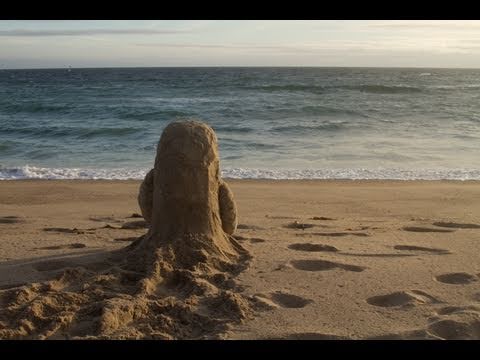
Bottle, and The Dog Who Was a Cat Inside are both low-budget, indie animations, that effectively work around their lack of production values by using cheap methods that compliment their visual style. Bottle uses litter found on the beach, sand, snow, and objects found in the forest, which are obviously free unless you have to pay mother nature for that stuff. Whereas The Dog Who Was a Cat Inside, uses a very simple art style and method for animation. Since the characters in it comprise of mainly shapes, they get away with animating it without putting much thought on the in-betweens, dodging many basic principles of animation, as well as animating at an exceptionally low frame-rate.


Bottle has some impressively consistent lighting, considering it's shot mainly outside, taking time of day and weather into account. The Dog Who Was a Cat Inside is also quite impressive in terms of this, as it manages to establish day and night effectively, as well as having rather smooth transitions between them.

It's unclear if the content for Bottle was meant to be telling us something. How the two characters meet is clearly meant to be synonymous with online dating, only it's through the classic note in a bottle trope. Of course they have to communicate that way, since they can't exactly swim to each other, but they end up connecting so much that they decide that they have to meet each other in person. They obviously only thrive in their own environment but want to meet each other anyway. This could also symbolise the online daters' own comfort zones being so opposite that they couldn't handle each other? In The Dog Who Was a Cat Inside, the content is quite clearly supposed to resemble a man that feels like a woman inside, and trying to come to terms with that. It could, however, also be about the difference between being masculine and feminine, and trying to find that harmonic balance between the two. Or it could just be about a dog trying to suppress it's inner catlike instincts. This one is a lot more open to interpretation than Bottle.

Bottle is pretty relevant for the time it was made, if my interpretation for the themes are correct, as online dating was very popular in 2010, to the point where dating sites were (and still are) even being advertised on TV. When The Dog Who Was a Cat Inside was released, in 2002, transgender was quite the touchy subject. No one really called it "transgender" that often, actually, because people thought it was a sexuality, and mainly referred to it as "transvestism", and people were referred to as "transvestites" regardless of whether or not they wore the opposite gender's clothing because they identified as them or just felt comfortable in them. Of course, this is still assuming The Dog Who Was a Cat Inside intended on actually having that correlation with this theme. Context would be a factor into this if it was the case.

There wasn't much emphasis on music in these shorts, in fact there was no music at all in Bottle, but they each work around this in their own ways. In Bottle, as I said, there is no music but rather environmental noises, depending on the setting the sounds were mainly ocean noises in the beach scenes, and windy noises in the snowy scenes. There is some very decent sound-design in this, actually, although the sound of the sand scraping the glass bottle goes right through me, I guess that's a good sign on their part though. The music in The Dog Who Was a Cat Inside was pretty generic Paris background music, nothing exactly to write home about, but it does establish the setting and tone effectively. The sound effects are also subtle but well done. It is rather obvious that the dog and cat noises were done by people, but I actually think it works here as it sounds rather silly, adding to the more comedic tone of this short.

Bottle was basically made to tell a cute love story with kind of a twist in the way it turns out, so it works in that sense. Like most indie shorts, it wasn't really meant for a specific target audience. The correlation in it should be more familiar with adults, but it doesn't exactly target them as an audience. It's tone of voice is appropriate for adults and young people, not being too dark or too light. It might actually be that the point of Bottle was to introduce kid's to these adult themes in a fairly light tone of voice. The Dog Who Was a Cat Inside is kind of similar in the sense that it kind of exists just to tell a cute story with real-world themes that a select group of people might be familiar with, but does it in a tone of voice that would appeal to both adults and children, though I think this might appeal to children slightly, because it's not as slow as Bottle and has that rather nice looking 2D/3D art style.

Subculture: My Thoughts.

Subcultures mainly consist of groups of people that like to distance themselves from the norm of society, typically due to the oppressive nature of whichever culture they belong to that demands that their social standards be met quite strictly. A few examples of this include goths, street punks, and hippies. This is typically done by dressing and styling themselves in a certain manner beyond social standards, as well as acting unconventionally. Sub-cultures are usually considered rather edgy and controversial, due to society's anxiety towards irregular folks within their community.

Subcultures are often looked down upon but some find their attitude and fashion-sense rather appealing. For this reason, you often find people not part of a subculture but still dressing like them. This has led many clothing stores to market their fashion products towards subcultures and people that look up to them. This kind of breaks the idea of subcultures, since the point of them is to go beyond the norm, and yet their style has become marketable.

Recently, "geek culture" has become rather popular, possibly due to TV series like Big Bang Theory and IT Crowd, and, in my opinion, it has actually led to a more positive perspective on geek culture within society, since before then it was considered more shameful to follow that lifestyle. Both the term geek culture, and people actually identifying as "geeks" is evident that this has essentially become another subculture. Granted, I am someone that by definition fits into this category of subculture but doesn't really identify as it. I feel like the difference between subcultures and everybody else is that they take pride in the fact that they are distancing themselves from society.

I personally think the very existence of subcultures is rather contradictory if the idea is go beyond the norm. They basically end up creating their own norm within their subculture, which is no different to what they were trying to avoid. I mean, are they trying not to conform by... conforming to their own culture? I don't have a problem with people being different, though. I wholeheartedly support individuality, but I don't think developing a group of people to celebrate this is necessarily the right thing to do. I always see subcultures as types of tribes, because people are basically forming a group based on their own differences and live in that particular manner. They create their own comfort zone because of this, and when they see other people/groups outside of that comfort zone, their instincts tend to vary between fascination, confusion, and irritation, most often the latter of the three. I believe this violent aspect of human nature as a species hasn't yet evolved since the Dawn of Man.

Saturday, 18 October 2014

Gaze and the Media

"According to usage and conventions, which are at last being questioned but have by no means been overcome - men act and women appear. Men look at women. Women watch themselves being looked at" (Berger 1972)
image
(1)
image
(2)
image
(3)
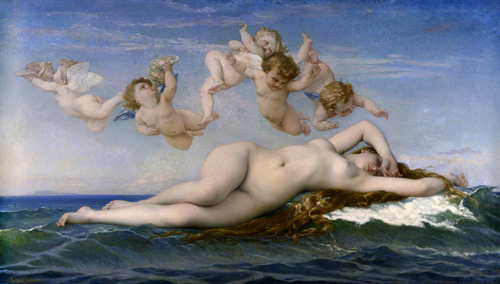
The “gaze” is a theory that describes how genders are stereotypically depicted by all forms of media. Women have been depicted as images to gaze at for centuries, and early works such as The Birth of Venus (1) are examples of this, because the central focus of the image is Venus, shown in a pose that gives the viewer permission to look at her body, and she is depicted resting and looking away from the audience.
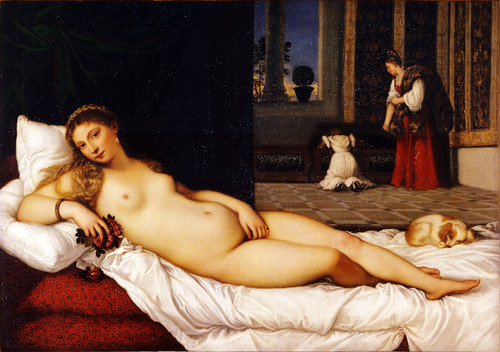
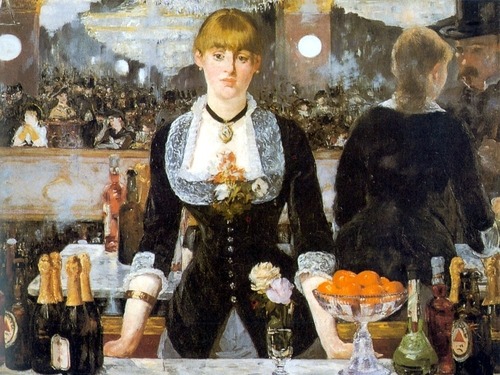
Venus of Urbino (2) depicts a woman resting in her personal environment and watches the viewer provocatively, meaning she knows the audience is watching her but lets them do so. The overall depiction of women in art are shown as nude grown up wealthy/holy women. Bar at the Folies Bergeres (3) explores the viewpoints of art, by placing a woman at a bar simply standing there waiting to take an order, with a mirror behind her showing her backside and a supposed image of the viewer watching her. The setting of the image is realistic but it destroys the concept of perspective by using the mirror behind the woman to show her at a different angle, which would otherwise not be there. It almost seems like the art is conspiring with the viewer to let us look at this regular woman from different angles.
image
(4)
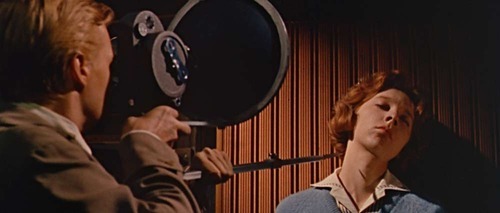
Contemporary media today takes advantage of the male gaze for advertising, using primarily nude models for billboards, magazine ads, etc. The film Peeping Tom (4) depicts objectification in a more sinister manner. It shows how objectification of female bodies affects real life female bodies, and shows the consequences of how that’s exploited in media.
image
(5)
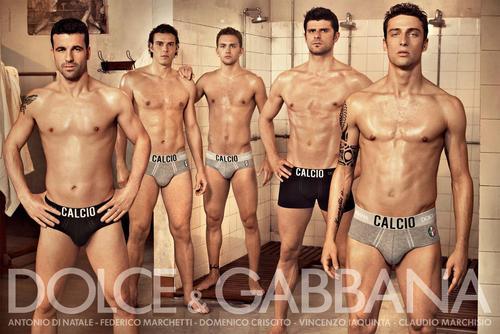
The gaze does not just refer to women, though. There are plenty of images in which men are objectified by media. Dolce & Gabbana (5) have made ad campaigns for underwear. It’s just not as heavy an issue, so to speak, for males. Audiences mainly identify with women as sexual objects, as opposed to men. There are obviously times where that’s not the case but in no way does that actually change anything.
Women are historically marginalised in art history by men, and this has led to women to typically be marginalised today.
image
(6)
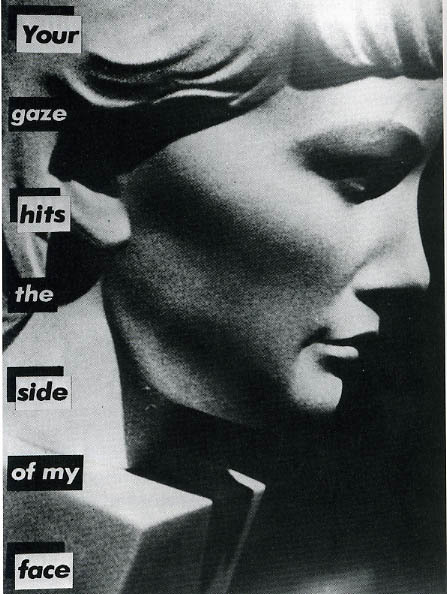
Barbara Kruger’s Your Gaze Hits the Side of my Face (6) is an image of a statue of a woman’s face with the quote, used for the title, in a similar manner to Peeping Tom, by conveying it in a violent manner, and showing that there are real-life consequences to it.
Reality television is an example of the gaze, by giving the audience permission to watch people just talking to each other in their private space and judging their actions. It’s basically giving people this power of voyeurism in a way. 
There have been plenty of campaigns speaking against objectification towards women in media, like the recent “Shut Down Page 3” campaign. Just like any other feminist campaign it ended up causing tonnes of abuse towards the campaign holders through social media.
Another common example of the gaze is the recent nude celebrity photo leaks of 2014, wherein many female celebrities (and like one dude) had nude photos leaked on the internet by people hacking cloud-based data storage.
The gaze affects male and female teenagers mainly, actually, solely due to online posts that supposedly want to relate to people insecure about their bodies, but only encourage the idea that you should worry about how you look and that objectification is something you should conform to.
image
(7)
image
(8)
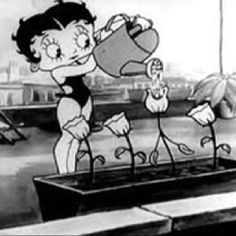
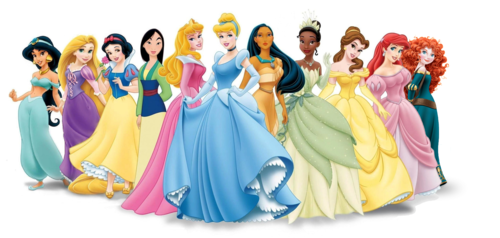
The gaze, overall, affects all forms of media today, movies, television, video games, magazines, art, etc. In terms of animation, it’s not really any different.Betty Boop (7) is a famous example, dating back to the 1920s. While the shorts she starred in were surreal and humourous by nature, there are still several times throughout her shorts (films, I mean, films) where the audience is given power to gaze at her. She was a memorable character that essentially set a standard for the female role in animation. Disney princesses (8), while not exactly conforming to male gaze, were designed in a manner that would make them pretty looking for audiences, even if that meant completely changing the character’s age, race, and personality from the film’s source material. Again, it’s not gaze material, but it does conform to trope of making female characters pretty so that they appeal to people more.
So the gaze has affected the media for centuries now and it has basically gotten to the point where it’s a social standard to objectify and overall give characters and people the model look to gaze at. I personally believe that there’s no changing that because humans as a species feel that empowered when given the opportunity to gaze, and that’s why it’s still happening.
image
(9)
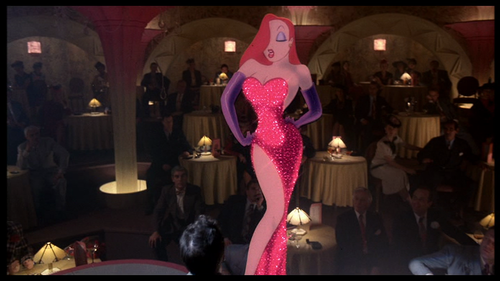
That’s also why it’s good for designers and writers to compromise creatively when characters are designed to be sexy. Jessica Rabbit (9) is another famous animated example. It’s pretty much deliberately over-the-top how sexualised she is, and I say that because while she is of course a sexy character, her design is also extremely disproportionate, with so much emphasis on her legs and bust that her waist is tiny and her legs are freaking tall. It’s seemingly a parody of the typical look given to female characters. Jessica Rabbit is also a pretty strong character, using her sexuality as a weapon most of the time. There’s also the fact the characters that harass her are all punished for it, while Roger Rabbit, the one who’s the most respectful towards her, is actually the one she loves, which I interpret as a moral to respect women, or anyone really, as humans and not just objects.
So I’m personally not against the gaze, I feel like that’s just a word that combines sexualisation and objectification, which I feel are two entirely different things. Sexualisation is acknowledging someone as sexy whilst still treating them as people, whereas objectification is simply treating a person as something to look at and use (like an object). A well-rounded character with sexual traits is far more appealing and respectful than a bland character with a nice body.